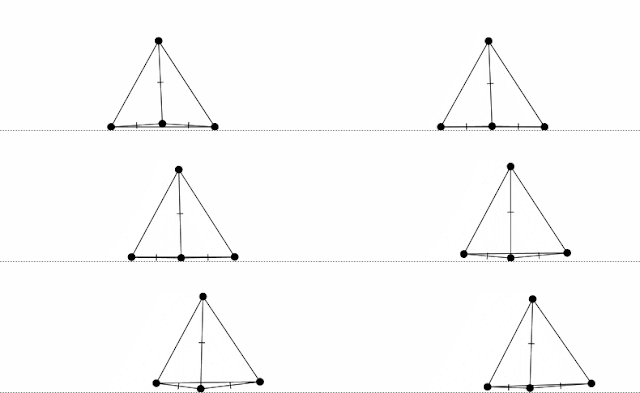
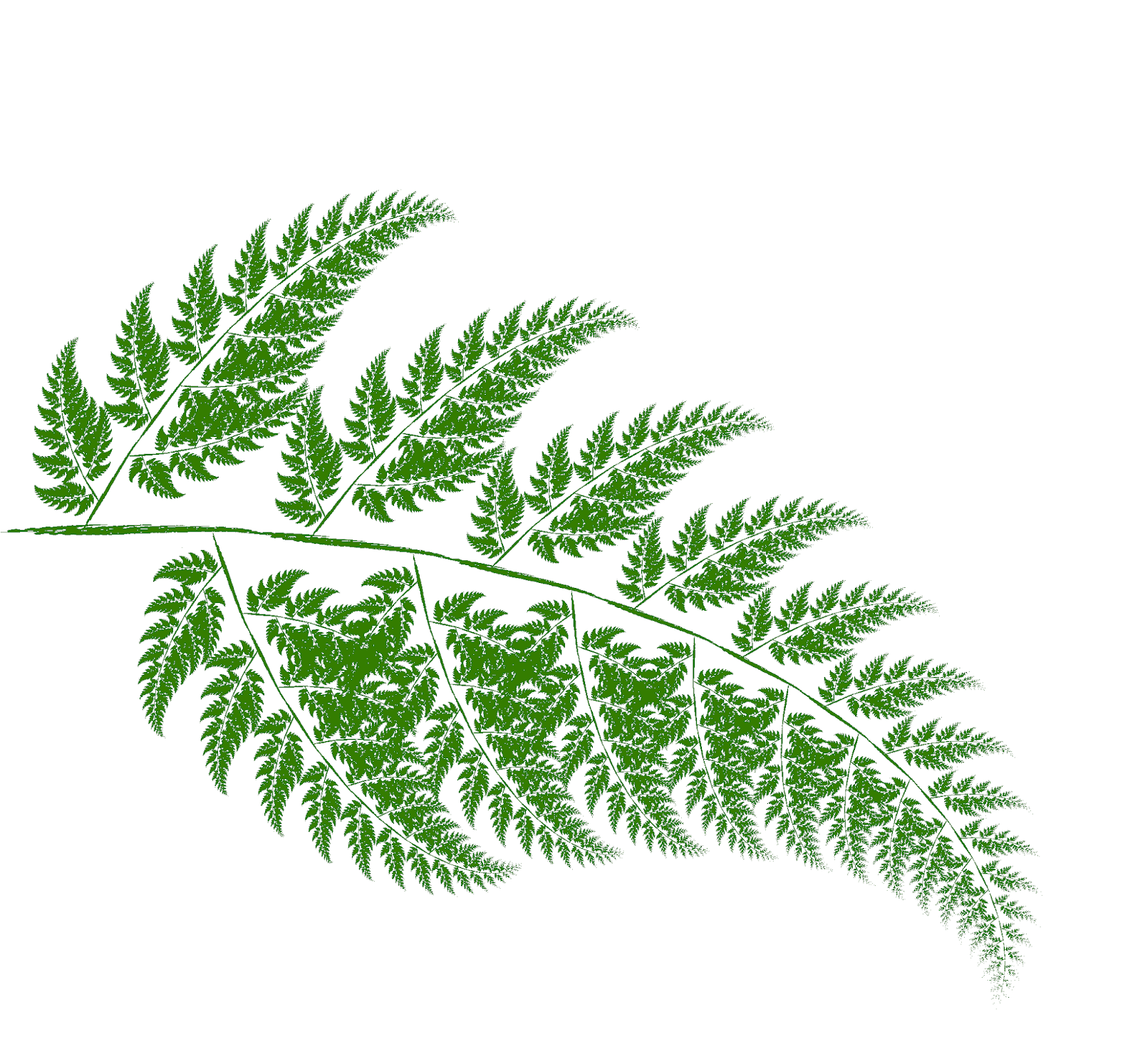
 My first try in IFS fractals iterated from simple equations.
x = a11 * x0 + a12 * y0 + c1;
y = a21 * x0 + a22 * y0 + c2;
where a's and c's take from the tables.
The tree:
// a11 a12 a21 a22 c1 c2 s J
 double a1[4][8]= { {-0.67, -0.02, -0.18, 0.81, 0.00, 1.02, 0.8530, 0.546},
{ 0.40, 0.40, -0.10, 0.40, -0.04, 0.06, 0.6217, 0.200},
{-0.40, -0.40, -0.10, 0.40, 0.04, 0.06, 0.6217, 0.200},
{-0.10, 0.00, 0.44, 0.44, 0.00, -0.14, 0.6263, 0.044}
};
The leave:
double a1[4][8]= { {0.240, -0.007, 0.007, 0.015, 0.000, 0, 0.004},
{0.220, -0.330, 0.360, 0.100, 0.540, 0, 0.149},
{0.140, -0.360, -0.380, -0.100, 1.400, 0, 0.160},
{0.800, 0.100, -0.100, 0.800, 1.600, 0, 0.687}
};
The code written here was C++ with PPM output. The number of iterations was
1e11 for leave and 1e9 for tree.
by Maciej Matyka (motivated by K. Graczyk :-)
Literature: J. Kudrewicz, Fraktale i chaos, WNT 2015
Update: see animated version here!.
---- code starts here
#include <cstdlib>
#include <iostream>
#include <fstream>
#include <ctime>
#include <random>
using namespace std;
const double xmin = -2.25;
const double xmax = 2.25;//15;
const double ymin = 0;
const double ymax = 5;
const double dx = (xmax-xmin);
const double dy = (ymax-ymin);
const int W=int(dx*280);
const int H=int(dy*280);
int pixels[W][H]={0};
//vector<float> X;
//vector<float> Y;
void plot(double x, double y)
{
int mx = int((x+dx/2)*W/dx); // -1.25 : 1.25
int my = int((y)*H/dy); // 0 : 6
if(mx<W&&mx>0&&my>0&&my<H)
{
pixels[ mx ][ my ] = 1;
}
}
void saveppm()
{
ofstream file("pix.ppm");
int c;
file << "P3" << endl;
file << "# dkfjsdljf" << endl;
file << W << " " << H << endl;
file << 255 << endl;
for(int j=0; j<H; j++)
{
for(int i=0; i<W; i++)
{
c = 255-pixels[i][H-j] * 255;
file << c << " " << c << " " << c << " ";
}
file << endl;
}
file.close();
}
 |
| Result of the code (in ppm format). |
// two stressed pilots
int main()
{
double x,y;
double x0,y0;
mt19937 mt_rand(time(0));
srand(time(NULL));
// J. Kudrewicz, p. 24
// a11 a12 a21 a22 c1 c2 s J
// choinka
double a1[4][8]= { {-0.67, -0.02, -0.18, 0.81, 0.00, 1.02, 0.8530, 0.546},
{ 0.40, 0.40, -0.10, 0.40, -0.04, 0.06, 0.6217, 0.200},
{-0.40, -0.40, -0.10, 0.40, 0.04, 0.06, 0.6217, 0.200},
{-0.10, 0.00, 0.44, 0.44, 0.00, -0.14, 0.6263, 0.044}
};
// paproc
/* double a1[4][8]= { {0.240, -0.007, 0.007, 0.015, 0.000, 0, 0.004},
{0.220, -0.330, 0.360, 0.100, 0.540, 0, 0.149},
{0.140, -0.360, -0.380, -0.100, 1.400, 0, 0.160},
{0.800, 0.100, -0.100, 0.800, 1.600, 0, 0.687}
};*/
// iterate
x0=0.1;
y0=0.6;
long int step=0;
int i;
const long int ITERATIONS = 1000000000;
//cout << mt_rand() << endl;
//return 0;
while(step++ < ITERATIONS)
{
//i = rand()%4; // 0-3
i = mt_rand()%4;
x = a1[i][0] * x0 + a1[i][1] * y0 + a1[i][4];
y = a1[i][2] * x0 + a1[i][3] * y0 + a1[i][5];
plot(x,y);
x0=x; y0=y;
if(!(step % (ITERATIONS/50)))
cout << "*";
}
cout << step << endl;
saveppm();
return 0;
}
---- code ends here